
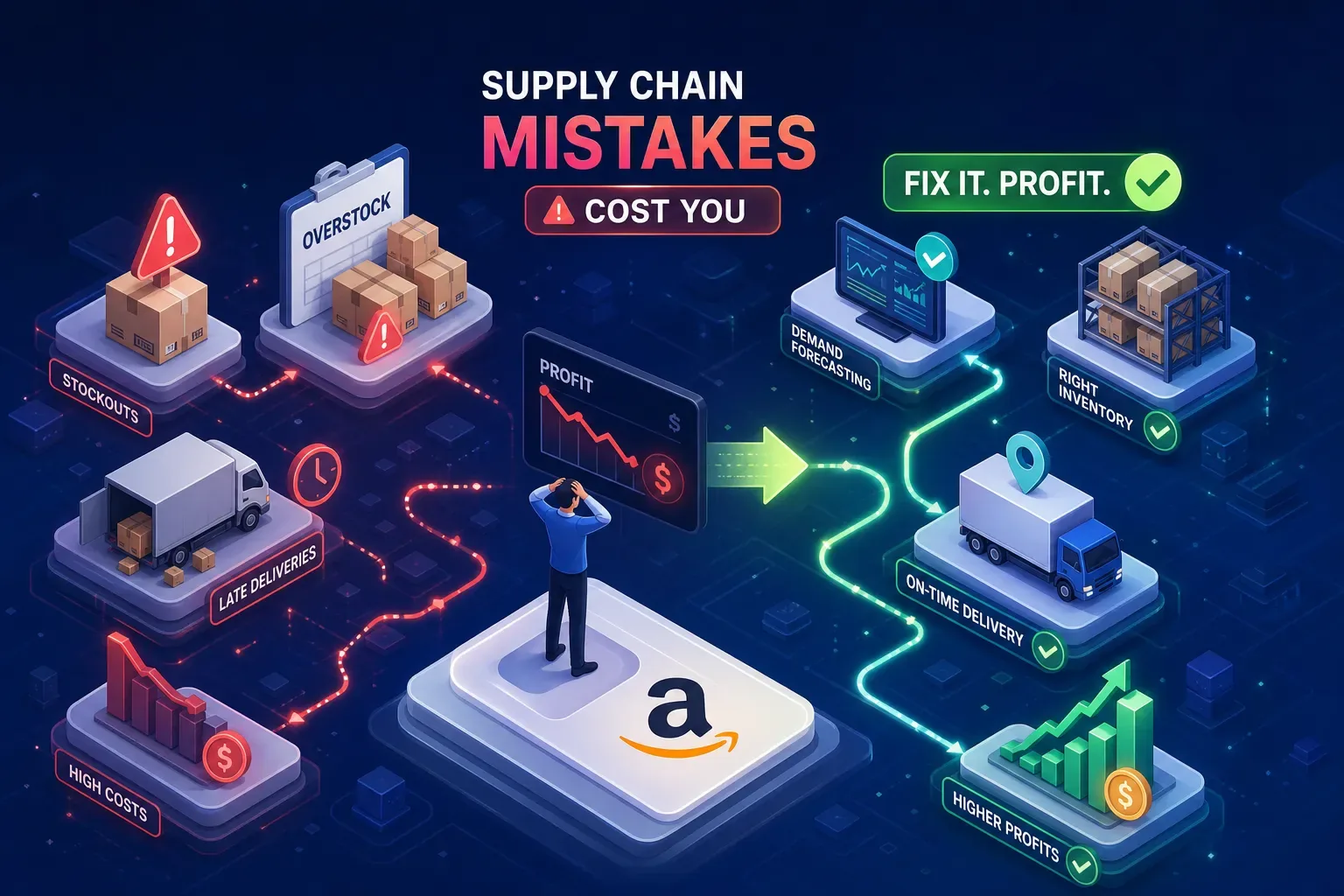
In Amazon supply chain management, most sellers don't lose money because their product is bad or their listing is weak. They lose money because their supply chain quietly bleeds margin through stockouts, preventable storage fees, and missed reorder windows that no one caught in time. The sellers who win on Amazon aren't always the ones with the best products. They're the ones who treat their supply chain as a system built intentionally, not a set of daily tasks managed reactively.
The good news is that the most damaging supply chain failures are predictable. They follow patterns, they leave early signals, and they have concrete fixes. At A2Z Supply Chain, we see these exact mistakes across the brands we work with, and we've built our entire ops model around catching and resolving them before they hit your margins. Here are the five costliest ones and exactly how to address each.
1. Amazon supply chain management mistake #1: Misreading FBA replenishment limits before peak season hits
Amazon's Inventory Performance Index (IPI) score functions as a dynamic ceiling on how much inventory you can send to fulfillment centers. The IPI measures four things: your excess inventory rate, sell-through rate, stranded inventory percentage, and in-stock rate. Sellers who fall below the 400-point threshold face hard limits on how many units Amazon will accept into its fulfillment network. Most sellers only discover this ceiling when they're trying to push a large replenishment ahead of a major sales period.
The seasonal trap works like this: a seller's IPI dips slightly in September because slow-moving summer SKUs are sitting in FBA. The score triggers a replenishment cap. Then Q4 demand spikes, and the seller can't send enough inventory to meet holiday orders. By the time they realize what happened, they're out of stock on their top SKUs during the most valuable selling weeks of the year. In practice, a stockout can cause organic search ranking to decay within 24 to 72 hours, and recovery often takes four to eight weeks, sometimes longer.
The fix is structural, not reactive. Build safety stock buffers and reorder schedules per SKU with IPI headroom factored in. Run a rolling 8 to 12-week inventory view at minimum. The goal is to be sending replenishment before the limit bites, not scrambling to request a capacity increase after your stock is already running low. This requires knowing your IPI trajectory weeks in advance, not just checking it when something feels off.
2. Amazon supply chain management mistake #2: Forecasting demand by feel instead of per-SKU data models
Multi-SKU catalog management breaks down fast when you forecast at the catalog level. A seller managing 80 SKUs who uses a single average weeks-of-cover number is treating a fast-moving consumable about to enter peak season the same as a slow-moving home goods item entering its slow season. By the time the blended number corrects, the fast movers are stocked out and the slow movers are racking up storage fees inside Amazon warehousing and fulfillment centers.
A solid per-SKU demand model separates three components that must never be collapsed into one figure. Trend captures the long-term sales direction of the SKU. Seasonality captures calendar-driven demand cycles specific to that product category. Promotional lift captures spikes from advertising campaigns, deals, and external traffic bursts. Collapse all three and your forecast will be wrong in the same direction every time, consistently underestimating demand at peaks and overestimating it in slow periods.
Automated reorder logic solves the execution gap that manual spreadsheets create. When a SKU's projected days-on-hand drops below a defined threshold, the system fires a purchase order or an alert to the ops team. The manual alternative is someone checking a spreadsheet weekly and making a judgment call, a process that introduces delays, human error, and no accountability for timing. For any brand managing more than 20 SKUs, the manual approach isn't a process. It's a liability.
3. Committing to a PO before modeling the real landed cost
This mistake erodes margins without anyone noticing until it's too late to change course. A seller calculates their costs using product cost and Amazon fees, then commits to a purchase order. The shipment arrives and the full tally comes in: ocean freight, port fees, a duty reclassification, domestic drayage, 3PL handling, and Amazon inbound routing surcharges. What was planned as a 35% margin lands at 18%. The inventory is already in transit. There's nothing left to renegotiate.
A complete landed cost model built before every PO must account for all of the following inputs:
Product unit cost
Inbound freight by mode (ocean, air, or ground)
Port and customs clearance fees
Duty rates and tariff classification
Domestic drayage or cross-docking
3PL prep and handling
Amazon inbound routing surcharges
Missing even two of these categories can shift your landed cost by several dollars per unit on a low-cost product. On a thin-margin SKU, that gap often means the difference between a viable business and a break-even line item you're better off discontinuing.
The practical application is straightforward: run the landed cost model on every SKU before the PO is signed. If the margin doesn't hold under a realistic freight scenario, you have three choices before committing: renegotiate the product cost, shift to a different shipping mode, or delay the order. The goal is that your planned margins match your actual margins, every time, not just when freight conditions happen to cooperate.
4. Running inventory across multiple channels without a unified view
Multi-channel selling amplifies every supply chain mistake that already exists. When the same inventory pool serves Amazon, Shopify, Walmart, and TikTok Shop without a single live view, over-allocation becomes routine. Consider a common scenario: a seller sends a large replenishment to FBA ahead of an Amazon promotion, which then underperforms. Meanwhile, Shopify DTC orders spike because of a viral social post, and there's no inventory left to ship. Those DTC sales are lost entirely, and in many cases, direct-to-consumer orders carry stronger margins than a discounted Amazon promotion would have generated.
A unified control tower solves the visibility problem. It consolidates every open purchase order, every 3PL location, every marketplace channel, and every in-transit shipment into one daily-reconciled view. This isn't a reporting dashboard. It's the operational layer that makes real-time channel allocation decisions possible. Without it, you're making inventory decisions on information that's hours or days old, which is exactly how over-allocation and channel stockouts happen at the same time.
Channel allocation rules are the mechanism that protects your highest-margin channel from running dry. Set pre-defined allocation by SKU: what percentage of available inventory is reserved for each channel, what inventory threshold triggers a reallocation review, and who has authority to override the rule when an exception occurs. These rules don't have to be rigid, but they need to exist. Without them, the channel generating the most purchase orders wins the inventory, regardless of which channel actually drives the most margin.
5. Reacting to supply chain exceptions instead of catching them early
Most supply chain fires are not surprises. They have early signals that go unread because no one is watching for them. A supplier in Vietnam confirms a ship date and then misses it by two weeks without flagging the delay. By the time the seller notices, FBA inventory has dropped to a critical days-of-cover level and Amazon's search algorithm has already started treating the listing as less reliable. A weekly production check-in tied to a lead time tracker, one that fires an alert when the confirmed date shifts more than three days, would have caught this two weeks earlier, while there was still time to respond.
Amazon's inbound routing requirements are another common exception source. As of January 1, 2026, Amazon ended its U.S. FBA prep and item labeling services, which means every shipment must arrive fully compliant before it reaches the fulfillment center dock. If a 3PL generates an inbound label to a fulfillment center that's no longer on the approved routing list, Amazon holds the shipment and charges an inbound defect fee.
Amazon's own documentation places the average defect fee at around $0.60 per unit, with industry sources reporting ranges of $0.32 to $1.74 per standard-size unit. Automated routing validation before every inbound label is generated substantially reduces this category of exception, and in a well-configured system, it eliminates the most common routing errors entirely.
Long-term storage fees are the third exception category that quietly drains margin. A product that sold well in Q1 and is sitting in FBA heading into Q3 with more than 180 days of inventory on hand is accumulating an aged inventory surcharge. Those fees start at $0.50 per cubic foot at 181 days and scale to $7.90 per cubic foot or $0.35 per unit (whichever is greater) past 456 days. A weekly aging report by SKU that flags any product exceeding a defined weeks-of-cover threshold, paired with a pre-built response playbook covering removal orders, price cuts, or bundling, turns a reactive cost into a managed one.
How a managed ops approach eliminates these mistakes at scale
Each of the five mistakes above has a structural fix. The challenge for most sellers isn't understanding the fix. It's having the systems and the coverage to execute it consistently across every SKU, every channel, and every supplier relationship simultaneously. That's where the operations model matters as much as the strategy.
At A2Z Supply Chain, our purpose-built ERP consolidates every channel, every open PO, and every 3PL location into a single live view, reconciled daily. Our ops pods run 24 hours a day across supplier and client time zones, which means exceptions get resolved overnight. Sellers wake up to decisions, not backlogs. Exception resolution time drops from days to hours because someone is always watching the signals and acting on them before they escalate.
Consider an illustrative example of what this looks like in practice: a multi-SKU brand managing 120-plus SKUs across Amazon and Shopify came to us losing approximately 12% of potential revenue to stockouts, while simultaneously paying significant FBA storage fees on slow movers. After transitioning to a managed ops model, with per-SKU demand forecasting, automated reorder logic, unified inventory visibility, and pre-commitment landed cost modeling on every PO, their stockout rate dropped by more than half within the first quarter and inventory turns improved steadily from there. The two problems that look like opposites, running out of fast movers while holding too much of slow movers, share the same root cause: forecasting and allocation done at the catalog level instead of the SKU level.
The decision point is straightforward. If you're managing more than 30 SKUs across two or more channels, spending more than 20 hours a week on supply chain decisions, or experiencing stockouts and excess inventory in the same quarter, a dedicated ops team is often worth considering. The margin you're losing to reactive management isn't a fixed cost of doing business. It's recoverable, once the right systems are in place.
Build the system, stop managing the fire
Strong Amazon supply chain management rewards sellers who build it as a system. It punishes those who manage it as a daily task list. The five mistakes covered here, IPI blind spots, catalog-level forecasting, unmodeled landed costs, channel allocation gaps, and reactive exception handling, are all predictable, all measurable, and all fixable with the right operational infrastructure.
The core fixes are reorder cadence with IPI headroom built in, per-SKU demand forecasting that separates trend from seasonality from promotional lift, pre-commitment landed cost modeling on every PO, unified inventory visibility across every channel, and proactive exception handling before signals become fires. When these systems are in place, the day-to-day rhythm of the business changes. Fewer fires, better margins, and inventory that moves instead of sitting.
If you're ready to hand this off to a team that runs it as a full-time function, reach out to A2Z Supply Chain. We'll walk through your current ops setup, show you exactly where the margin is leaking, and explain what it takes to stop it, so you can get back to running the business instead of fighting it.