
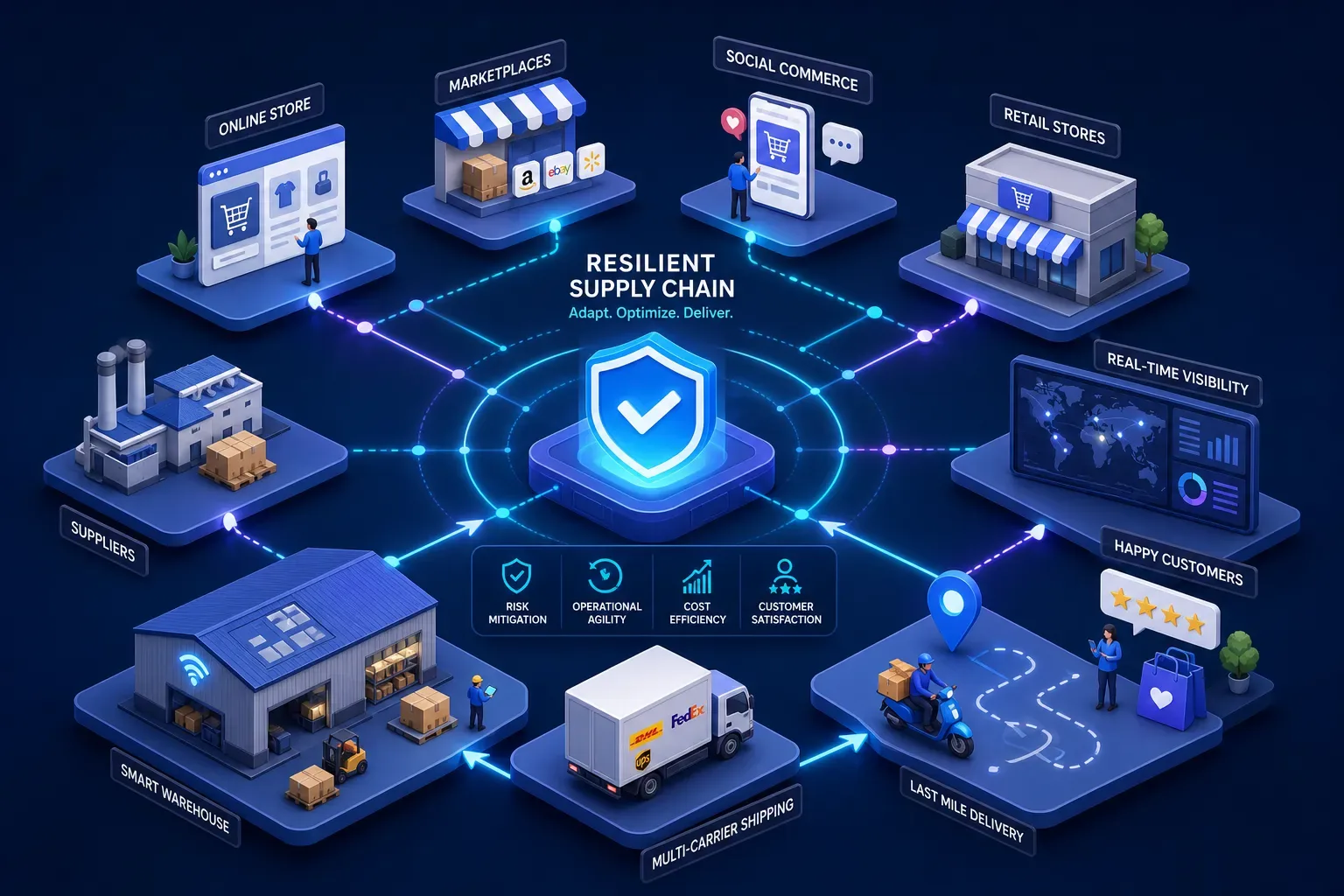
Many multi-channel e-commerce brands struggle not because of bad products, but because of broken operations. Research on stockout and overstock losses consistently points to operational gaps, not product-market fit, as the primary margin killer for growing brands. A brand selling on Amazon, Shopify, and Walmart simultaneously faces a compounding problem: every channel has different replenishment rules, lead times, and compliance demands. Without a clear framework connecting the moving parts, even fast-growing brands hit a wall of stockouts, overstock, and margin bleed that no amount of marketing spend can fix.
At A2Z Supply Chain, we frequently observe this pattern across the brands we work with. The fix isn't more spreadsheets, spreadsheets introduce data latency, reconciliation drag, and zero real-time integration, or faster shipping options alone. It's a structured approach to logistics and supply chain management that connects demand forecasting, supplier coordination, and inbound logistics into a single operating system. This article walks through the core concepts, the frameworks that work, and five practical steps any multi-channel brand can apply starting now.
Logistics vs. supply chain management: why the distinction matters
Logistics is the execution layer: moving, storing, and delivering goods. It includes transportation and warehousing, order fulfillment, and inbound freight coordination. When a brand asks "why did my FBA shipment arrive late?", that's a logistics question. It's operational, measurable, and tied directly to physical product flow.
Supply chain management (SCM) is the strategic layer above logistics. It includes sourcing, procurement, demand planning, supplier coordination, inventory policy, and channel allocation. SCM answers the question "are we ordering the right quantity from the right supplier at the right time?" Logistics executes the plan; SCM builds it.
Multi-channel brands frequently treat SCM problems as logistics problems. They optimize shipping rates while ignoring demand planning gaps. Getting clear on which layer is broken is the fastest way to stop solving the wrong problem. If you're consistently late on FBA replenishments, the fix might not be a faster carrier, it might be a better reorder point model.
Logistics and supply chain management: the three pillars of every distribution network
Transportation is typically the largest line item in logistics cost. For e-commerce brands, it covers inbound freight from suppliers, domestic transfers to 3PLs or FBA, and last-mile delivery to customers. Route optimization, load consolidation, and carrier diversification are the levers that move this number. Even a modest reduction in freight cost per unit adds up quickly at scale, a $0.50 savings per unit on 100,000 annual units is $50,000 back in margin.
Warehouses don't just store product. They act as a buffer between unpredictable production timelines and unpredictable customer demand. How many facilities you use, where they're located, and how they handle receiving, cross-docking, and fulfillment all affect your service levels and your inventory carrying costs. Positioning inventory closer to demand reduces transit time but adds warehousing overhead, so every network decision involves a real trade-off.
Inventory policy answers how much stock sits at each node in your network. Set it too high and you tie up working capital. Set it too low and you stock out. The right policy connects your demand forecast to your supplier lead time and your warehousing footprint. Transportation strategy and warehousing decisions are only as good as the inventory logic sitting beneath them.
Where multi-channel sellers lose control
Most multi-channel brands oscillate between two failure modes: stockouts that kill ranking and revenue, and overstock that ties up cash and triggers storage fees. The root cause is almost always the same: demand signals from each channel are being managed in silos rather than consolidated into a single planning view. Amazon velocity, Shopify DTC trends, and Walmart WFS sell-through rates are all telling you something different, and they need to be reconciled before you can plan accurately.
When demand forecasting is disconnected from purchasing, purchase orders go out too late or for the wrong quantities. That triggers expedited freight, airfreight premiums, or split shipments that increase cost and reduce in-stock reliability. Supplier lead times get ignored or underestimated, and the whole system starts operating reactively. Each exception costs time, margin, and team bandwidth.
The metrics that matter most for multi-channel supply chain health are OTIF (on-time, in-full), inventory turnover, and perfect order rate. OTIF tells you whether the chain is delivering what it promised, when it promised it. Inventory turnover tells you whether capital is working efficiently. Perfect order rate tells you whether the end-to-end system is reliable at the order level. Tracking these together paints a clear picture of where the chain is breaking down before a crisis forces your hand.
Per-SKU demand modeling and landed cost forecasting
Effective demand forecasting at the SKU level separates three distinct signals: baseline trend, seasonality, and promotional lift. A brand running a Prime Day promotion needs to strip that lift from its baseline before projecting forward, otherwise the inflated numbers contaminate future reorder calculations. Scoring each SKU's model regularly against actual sales (weekly works well for fast-moving e-commerce SKUs, though the right cadence depends on volume and variability) means the forecast self-corrects continuously rather than drifting over a full quarter. This is how reorder points stay accurate even as market conditions shift.
Landed cost forecasting takes the demand model one step further. Before a purchase order is confirmed, every cost element is modeled per SKU: ocean freight, port fees, duties, domestic drayage, and applicable tariff surcharges. This ensures that planned margins match actual margins when the product arrives. Brands that skip this step regularly discover their "profitable" SKU was margin-negative by the time it hit their 3PL.
Here's a practical example of why this matters in real time. A supplier signals a two-week delay on a core SKU. Without a demand model tied to supplier lead times, that delay surfaces as a stockout three weeks later. With a per-SKU model running live against sales velocity and reorder points, that exception triggers an alert the same day. The ops team can then decide whether to air freight a partial quantity, reroute from another supplier, or pre-position safety stock from an existing location. The decision is proactive, not reactive.
Supply chain visibility and the unified control tower
A control tower in logistics and supply chain management consolidates every open PO, every 3PL inventory position, and every marketplace channel into a single live view, updated at high frequency or near-real-time for modern platforms. For a brand selling across Amazon, Shopify, Walmart, and TikTok Shop, this means one place to see inbound freight status, on-hand inventory by location, channel allocation, and pending replenishments. Without this level of supply chain visibility, operations teams are reconciling spreadsheets from multiple sources and making decisions on stale data.
Supply chain exceptions don't respect a 9-to-5 schedule. A customs hold, a receiving discrepancy at a 3PL, or a delayed FBA check-in lands overnight or across time zones. A dedicated ops pod that operates around the clock resolves these exceptions before the client wakes up, and that's exactly how A2Z Supply Chain structures its managed operations. The difference in practice is significant: instead of starting the morning with a crisis, the team starts with a decision brief. The exception has already been triaged. A resolution path has been initiated.
Generic ERPs weren't designed for the specific demands of multi-channel e-commerce, they lack real-time marketplace feeds, struggle with 3PL connectivity, and offer limited orchestration across channels. A purpose-built system syncs channel sales velocity, supplier lead times, 3PL inventory, and open POs in near-real-time. Replenishment calculations run automatically. Channel allocation adjusts when one marketplace surges. The result is a system that surfaces the right information at the right time, rather than requiring a team member to manually pull and reconcile data from six platforms every morning. This is the operational foundation A2Z Supply Chain builds for every client from day one.
Five practical steps to strengthen your logistics and supply chain management today
Step 1: Build reorder points from actual lead time data
Stop using gut estimates for reorder timing. Pull supplier lead time history for each SKU, calculate the average and variance, and set reorder points that account for that variance. Add a safety stock buffer sized to your demand variability. This single step eliminates a large percentage of stockouts for brands that have historically managed replenishment manually.
Step 2: Model landed cost before every PO, not after
Make landed cost modeling a mandatory step in the purchase order workflow. Before any PO is approved, calculate the freight estimate, duty rate, and applicable surcharges per unit. For example, a duty rate change of just 5% on a $20 landed item can flip a SKU from profitable to breakeven overnight, catching that before the PO ships is the difference between a planned adjustment and a margin crisis. This keeps projections accurate and surfaces cost surprises before they ship, not after they arrive at your 3PL dock.
Step 3: Consolidate your channel inventory view into one place
If your inventory position across Amazon, Shopify, Walmart, and your 3PL lives in separate systems, consolidate it. Whether you use a purpose-built ERP or a dedicated inventory management platform, the goal is one reconciled view updated at a consistent cadence. This is the prerequisite for every other optimization on this list.
Step 4: Separate replenishment planning from reactive firefighting
Most small ops teams spend the majority of their time reacting to exceptions rather than planning ahead. Structure your week so replenishment decisions happen proactively on a fixed cadence, separate from daily exception handling. This creates space for strategic planning and prevents urgent problems from crowding out important ones.
Step 5: Measure OTIF, inventory turnover, and perfect order rate consistently
Choose your KPIs and track them on a regular cadence, for fast-moving e-commerce SKUs, weekly tracking is practical and gives you enough resolution to catch problems early. OTIF, inventory turnover, and perfect order rate give you a complete read on whether the chain is reliable, capital-efficient, and delivering accurately. When a metric starts trending in the wrong direction, you have the data to identify which layer, logistics or supply chain management, is causing it before it becomes a crisis.
Building a supply chain that scales with your brand
Brands that scale across Amazon, Shopify, Walmart, and other marketplaces without constant operational chaos share a common foundation: they connect demand forecasting to supplier coordination, model landed costs before committing capital, and maintain one live view of their entire operation. Sound logistics and supply chain management isn't reserved for enterprise players with nine-figure budgets, it's a set of frameworks, data practices, and team structures that any growing brand can build systematically.
If your team is spending more time firefighting than planning, that's a signal the system needs structure, not more manual effort. The five steps above are a starting point, but for brands managing dozens of SKUs across multiple channels, the compounding complexity demands a more complete solution than any single tool or checklist can provide.
A2Z Supply Chain exists precisely for this moment: when a brand is ready to hand off supply chain operations to a purpose-built team so the founders can focus on growth. Reach out to our team to see how a managed ops pod changes what your mornings look like.