
The bullwhip effect in ecommerce: what it is and how to stop it
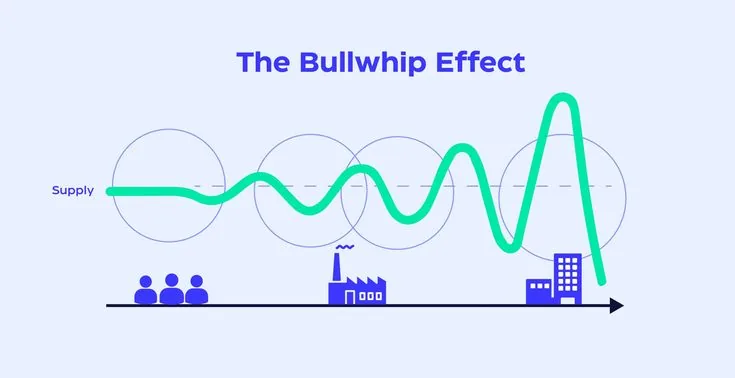
Quick answer: The bullwhip effect is what happens when a small demand spike gets amplified at every step of the supply chain. You sell 10 extra units, you order 100, your warehouse orders 1,000, the factory buys raw material for 10,000. The fix is sharing real sales data with suppliers and ordering smaller batches more often, instead of guessing and over-correcting at every link.
You sell 10 extra units of a product on Tuesday.
You panic and order 100 extra units from your warehouse. Your warehouse panics and orders 1,000 extra units from the factory. The factory buys enough raw material for 10,000 units.
That's the bullwhip effect. A tiny twitch at the cash register turns into a violent swing by the time it reaches the far end of the supply chain, and you're the one left holding a warehouse full of deadstock. Here's why it happens and how to actually stop it.
People react to noise
A sudden traffic spike from a viral video looks like a permanent trend, even when it isn't.
Brands misread that short-term bump as long-term demand, then inflate their purchase orders to match, assuming the new sales velocity is here to stay. It rarely is, and by the time the data proves that, the order's already placed.
Long lead times make it worse. If your factory takes 60 days to deliver, you're stuck guessing what the market looks like two months out. And guessing, more often than not, leads to over-ordering.
Break the batching habit
Factories offer deep discounts for large orders, and buyers love a cheap unit price.
So orders get bundled: three months of inventory in one purchase order, just to save a few cents per unit. That looks efficient on a spreadsheet, but it blinds the manufacturer. They sit idle for weeks, then scramble to produce a massive batch all at once, and that scramble is exactly where quality control slips and deliveries run late.
Share the real numbers
Give your factory access to your actual daily sales velocity, not a rounded-up forecast.
When they can see the real numbers, they stop guessing too. They prepare raw materials based on what's actually selling, and they know roughly when your next order is coming instead of waiting for a surprise PO.
Order smaller batches, more often. Yes, you'll pay a slightly higher unit price. You'll also save a lot more than that in storage fees, and you'll sidestep deadstock almost entirely.
Keep your supply chain calm with A2Z Supply Chain
Stop guessing your order volumes. A2Z Supply Chain builds the math so the guessing stops at every link, not just yours.
Demand forecasting: We calculate exact order quantities using hard data, not a reaction to last week's spike.
Inventory planning: We set precise reorder points, so panic-buying isn't the default response to a good sales day.
Supplier coordination: We share clean, accurate forecasts with your factories, so they're producing against real signals.
Logistics: We keep small, frequent batches moving to bypass the storage fees that come with bulk orders.
Round-the-clock support: Our ops pod works 24/7 on Slack to keep your supply chain steady, not reactive.
The bullwhip effect isn't caused by bad intentions anywhere in the chain. It's caused by everyone guessing separately instead of working off the same real number.