
3PL vs. In-House Fulfillment: When Should an E-Commerce Brand Switch?
In the early days of building a brand. Packing boxes yourself out of a garage or a small leased space feels almost like a rite of passage. You control the unboxing experience, and overhead looks low on paper. But as order volume climbs, that "control" starts turning into the exact thing slowing you down.
Most founders eventually hit a point where they're spending more time printing shipping labels than actually growing the business. If logistics is what's throttling your growth, you're facing the same decision every scaling brand eventually runs into: 3PL vs. in-house fulfillment. Here's how to know you've actually outgrown self-fulfillment, and why making the switch at the right time matters more than most people think.
The Hidden Costs of In-House Fulfillment
Plenty of brands hold off on a 3PL because they look at the quote and think, "I can do this cheaper myself." That comparison usually misses the real costs sitting underneath in-house logistics:
Opportunity cost. Every hour spent packing boxes is an hour not spent on marketing, product development, or bringing in new customers.
Lease liabilities. Warehouse space means a long-term lease. A slow quarter doesn't make that payment go away. You're still covering empty square footage either way.
Volume caps. In-house fulfillment doesn't flex. If a product goes viral and 5,000 orders show up overnight, a small internal team can take weeks to work through them, and that usually means angry customers and canceled orders.
Signs It's Time to Switch to a 3PL
The right time to switch is a data question, not just a "we're exhausted" question. If any of these sound familiar, it's probably time:
You're processing 300–500+ orders a month. Past this point, the manual labor involved starts costing more than it saves.
You're running out of storage. If inventory is clogging aisles and creating safety hazards, your physical space is now capping your purchasing power too.
Your shipping error rate is climbing. More volume on a stretched team usually means more wrong SKUs and missed cutoffs.
You're expanding into Amazon FBA. FBA's labeling and routing requirements are strict, and a specialized 3PL can prep and cross-dock those shipments far more reliably than an internal team juggling everything else.
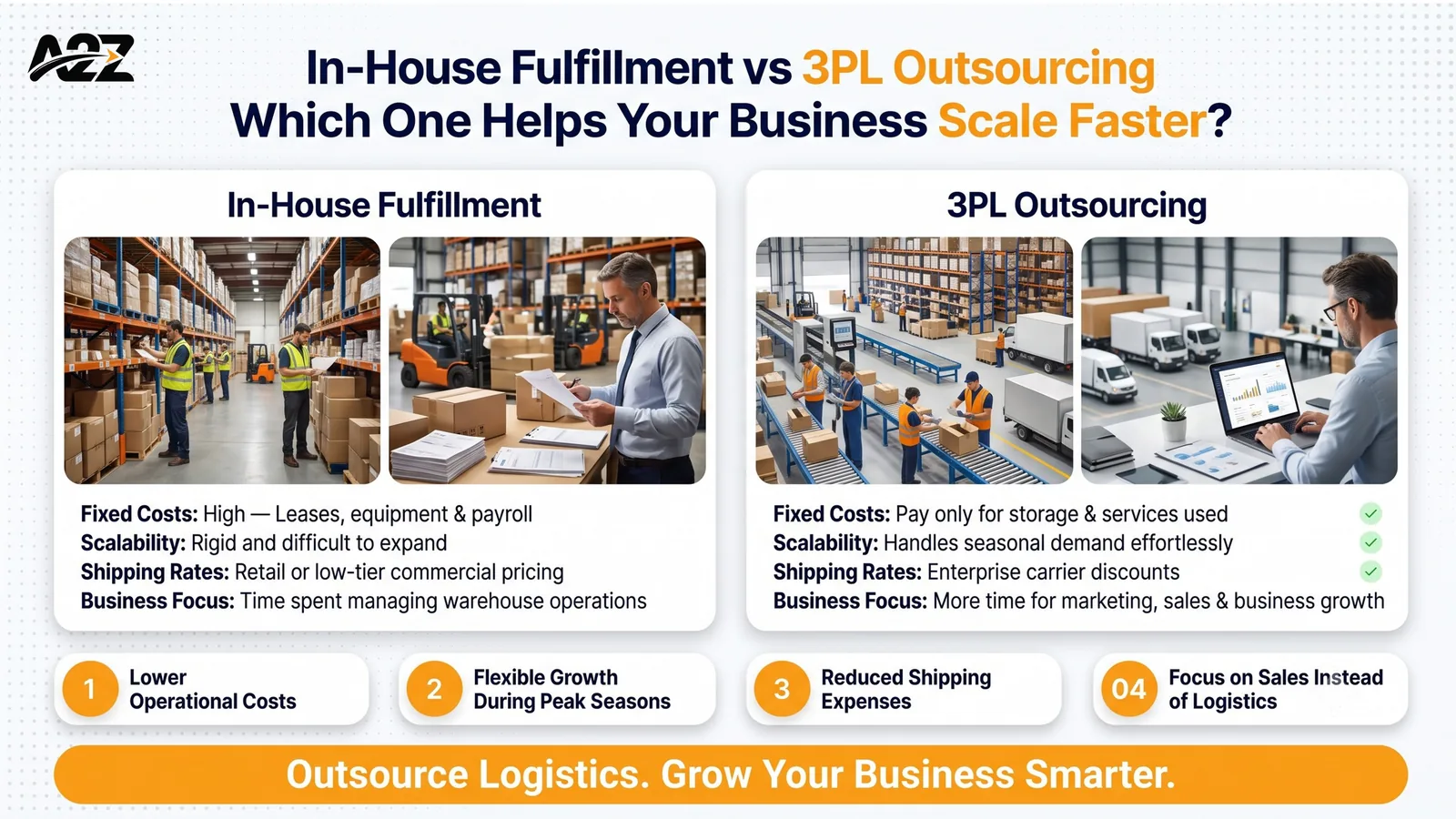
3PL vs. In-House Fulfillment: A Direct Comparison
Fixed Costs
In-House Fulfillment: High leases, equipment, payroll
3PL Outsourcing: Low pay only for space and services used
Scalability
In-House Fulfillment: Rigid, hard to flex up or down
3PL Outsourcing: High; absorbs volume spikes easily
Shipping Rates
In-House Fulfillment: Retail or low-tier commercial discounts
3PL Outsourcing: Deep enterprise carrier discounts
Focus
In-House Fulfillment: Pulls time away from core business tasks
3PL Outsourcing: Frees up time for marketing and growth
Let A2Z Supply Chain Orchestrate Your Logistics
Switching to a 3PL doesn't have to mean managing the relationship, the software integration, and the freight coordination yourself. A2Z Supply Chain removes that friction by acting as the central nervous system for your entire supply chain. It's not just handing you off to a warehouse, but running the flow of goods from the factory floor to your customer's door.
Logistics & Cross-Docking: We orchestrate 3PLs, direct-to-FBA routing, and cross-docking ourselves, from inbound ocean freight to the last mile, keeping your product on schedule and your landed costs predictable.
Inventory & Demand Planning: We set dynamic reorder points, safety stock buffers, and channel allocation, so your 3PL always has the right stock in the right place at the right time.
Machine Learning Forecasting: Our ML models translate sales history and promotional lift into concrete numbers, telling you exactly what to send to the 3PL so you never overorder.
Supplier Coordination: We manage POs, lead times, and QC directly with your factories, catching issues before they ever ship to your fulfillment centers.
Round-the-Clock Communication: A dedicated operations pod is reachable via Slack and email, 24/7. Whether it's a 3PL question or a delayed carrier, someone's already on it.
The result is one dashboard, real-time visibility across every SKU and shipment, and forecasting that's actually reliable. Not a guess dressed up as a plan. You focus on growing the brand; we make sure the right inventory lands in the right place, on time, every time.